





Introduction
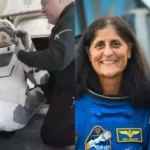
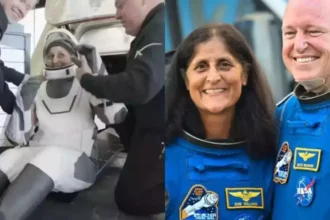
Sunita Williams is a name that resonates with excellence, perseverance, and groundbreaking achievements in space exploration. As a veteran NASA astronaut, she has played a significant role in advancing human spaceflight, conducting crucial scientific research aboard the International Space Station (ISS), and inspiring countless individuals around the world.
Early Life and Education
Sunita Lyn Williams was born on September 19, 1965, in Euclid, Ohio, to Indian-American father Deepak Pandya and Slovenian-American mother Bonnie Pandya. She was raised in Needham, Massachusetts, where she spent much of her childhood exploring and developing a keen interest in science and aviation. Williams graduated from Needham High School in 1983 and pursued her higher education at the U.S. Naval Academy, where she earned a Bachelor of Science degree in Physical Science in 1987.
After completing her undergraduate studies, Williams was commissioned as an ensign in the United States Navy. Her passion for aviation led her to obtain a Master of Science degree in Engineering Management from the Florida Institute of Technology in 1995.
Naval Career and Becoming an Astronaut
Williams began her naval career as an aviator, training as a helicopter pilot. She became a Naval Test Pilot and served in various operational and testing roles. Over her military career, she logged more than 3,000 flight hours in over 30 different aircraft types, showcasing her exceptional piloting skills.
In 1998, Williams’ career took a transformative turn when she was selected as an astronaut candidate by NASA. Following rigorous training, she officially became a NASA astronaut, marking the beginning of her journey into space exploration.
First Space Mission: Expedition 14/15 (2006-2007)
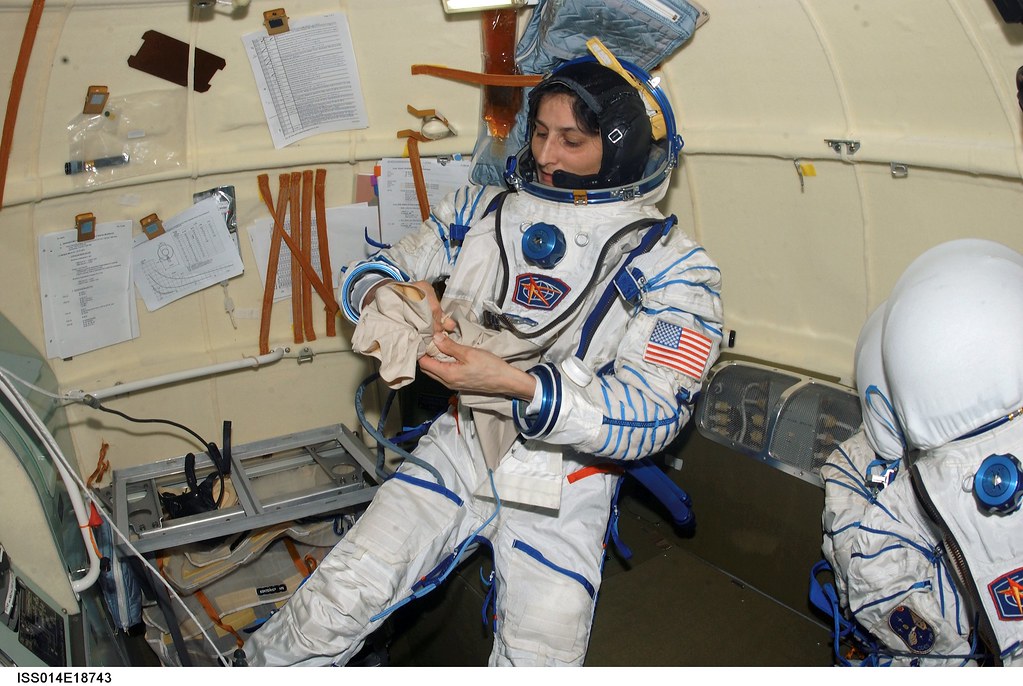
Sunita Williams’ first mission to space was as a Flight Engineer for Expedition 14/15 aboard the ISS. She launched aboard the Space Shuttle Discovery on December 9, 2006, as part of mission STS-116.
During her six-month stay on the ISS, Williams conducted various scientific experiments and maintenance tasks. However, her most notable achievement during this mission was setting a record for the most spacewalk time by a woman. She performed four spacewalks totaling 29 hours and 17 minutes, breaking the previous record held by astronaut Peggy Whitson.
Additionally, Williams was known for her engaging interactions with the public while aboard the ISS. She ran the Boston Marathon in space on a treadmill, inspiring fitness enthusiasts and demonstrating the importance of exercise in microgravity.
She returned to Earth on June 22, 2007, aboard STS-117, completing a mission that cemented her legacy as a pioneering astronaut.
Second Space Mission: Expedition 32/33 (2012)
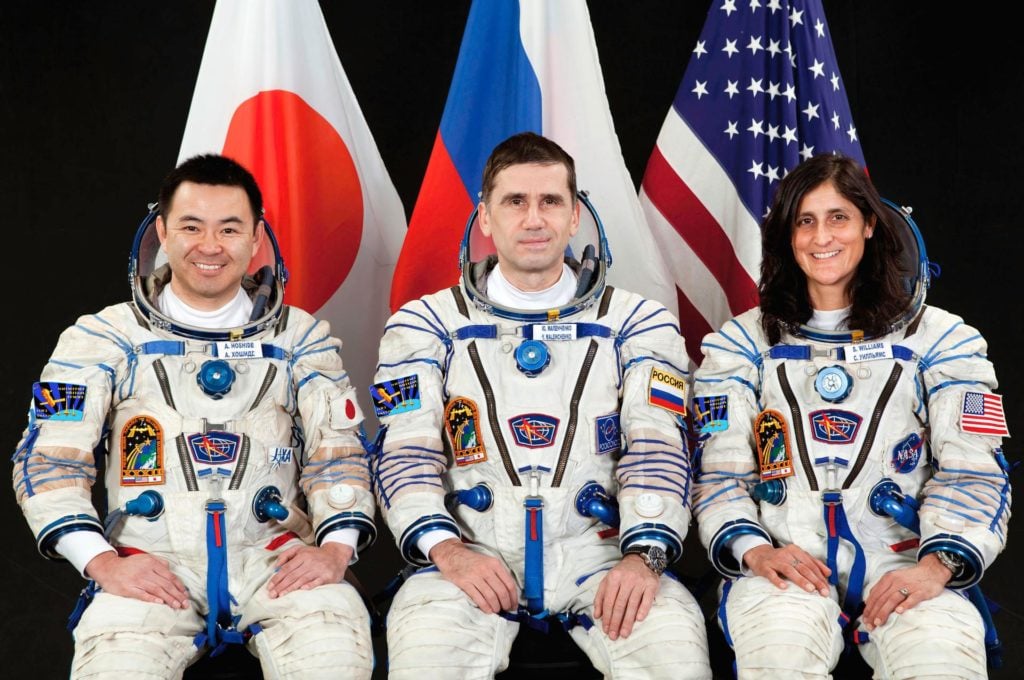
Williams returned to space on July 15, 2012, as a Flight Engineer for Expedition 32 and later took over as Commander of Expedition 33. This made her only the second woman to command the ISS, a significant milestone for women in space exploration.
During this mission, she conducted three additional spacewalks, bringing her total spacewalk time to 50 hours and 40 minutes—the most by any female astronaut at the time. She played a crucial role in installing new hardware, repairing malfunctioning equipment, and conducting scientific research essential for future deep-space missions.
One of the highlights of her second mission was participating in the first-ever triathlon in space, a feat that further demonstrated her resilience and ability to adapt to the challenges of long-duration spaceflight.
After 127 days in space, Williams and her crew safely returned to Earth on November 19, 2012.
Contributions to Space Science and Research
Throughout her two space missions, Sunita Williams conducted extensive research that has contributed significantly to the understanding of human physiology in microgravity. Her work has helped scientists analyze the effects of long-duration space travel on the human body, particularly in preparation for future missions to the Moon and Mars.
Her participation in various extravehicular activities (EVAs) helped upgrade the ISS infrastructure, ensuring its continued operation as a hub for international space research. Additionally, Williams actively engaged in educational outreach, connecting with students worldwide through video calls and live demonstrations from the ISS.
Commercial Crew Program and the Future of Space Travel
Following her return from Expedition 33, Williams took on an essential role in NASA’s Commercial Crew Program, which aims to develop privately built spacecraft for ferrying astronauts to and from the ISS. In 2015, she was selected as one of the astronauts to test Boeing’s CST-100 Starliner, a next-generation spacecraft designed for NASA’s commercial spaceflight missions.
Although her return to space was delayed due to technical issues with the Starliner, Williams continued to contribute to the program through extensive training and mission simulations. She remained an active advocate for space exploration and played a vital role in mentoring the next generation of astronauts.
Inspiring Women in STEM and Space Exploration
Sunita Williams is a role model for women in STEM (Science, Technology, Engineering, and Mathematics), particularly those aspiring to careers in aerospace and space exploration. As one of the few women to have commanded the ISS, she has paved the way for future female astronauts and engineers.
Her Indian-American heritage has also made her an inspirational figure in India, where she has been celebrated for her achievements. Williams has frequently visited India to engage with students and encourage young minds to pursue careers in science and technology.
Awards and Honors
Williams has received numerous awards and recognitions for her contributions to space exploration and the U.S. Navy. Some of the notable awards include:
- NASA Spaceflight Medal (twice)
- Navy Commendation Medal
- Legion of Merit
- Padma Bhushan (India) – One of India’s highest civilian honors
Her dedication and accomplishments continue to be recognized globally, solidifying her status as a trailblazer in space exploration.
Conclusion
Sunita Williams’ journey from a naval aviator to an esteemed astronaut is a testament to her perseverance, passion, and commitment to advancing space exploration. Through her record-breaking spacewalks, leadership aboard the ISS, and contributions to the Commercial Crew Program, she has left an indelible mark on NASA’s spaceflight history.
As we enter a new era of space exploration with missions to the Moon and Mars, Sunita Williams’ legacy will undoubtedly serve as an inspiration for future astronauts and scientists. Her story is a reminder that with determination and hard work, the sky is not the limit—it’s just the beginning.